
Shhh ...
... you really can't talk about that, not here, not now ... ever

I got some groceries, some peanut butter
To last a couple of days
— Life During Wartime, Talking Heads
To: Helric Fredou, Sylvia Stolz, Robert Faurisson, Ernst Zundel, Monika Schaeffer, Horst Mahler, Albert Schaeffer, David Cole
[Chapter one]
I shoulda been a cowboy.
— Toby Keith
“Excuuuse me. ...
“And I said, excuse me. ...
“... I said exxxcussse ... me.”
He walked along the dusty path, a snowmobile trail in the winter.
He stumbled here and there, in his steps, his recounting the song, singing out loud, not in his head for once. It was necessary at this point to hear himself, to convince himself to keep going, to let the bears and wolves know he was coming and so to perhaps run away, or perhaps as well to line the parade path with knife and fork, also to hope to inform the turkey vultures circling, not yet.
So tired.
Would the car even be there? And then he’d be walking back. He’d die. He would just sit down and die. The New York Times headline would say, “He Just Sat Down And He Died.” That is probably how some people commit suicide. They just sit down. They have to say something like mio-cardial-fart-action, but really he just sat down and decided this was far enough. It really should be that easy. Why does it have to be so hard?
Blisters. He could picture them, knew right where they were, on the left foot. So he concentrated on walking with his right foot, how pain-free was the right foot, how clear of rocks this particular path, the little breeze that almost kept off the black flies, maybe some call ‘em deer flies. Their bite actually hurts, but they are slow and easy to kill.
And the New York Times article continued about how this guy had nine children and how they loved him and he played golf here, banked right there, was a member of this and that, had once done this and was so proud of that fact, and that all [most at most inferred] loved him and will miss him and that his ashes will be flown to, spread, placed, stored and dumped all over hell.
In the glove box of a cherry red Chevrolet Impala circa 1960, in the grove of trees behind Dale’s Deluxe Deals, in the hot sun, twenty-below, seventy wind-chill, trapped flies buzzing, home of a struggling though happy mouse family of 39. And this is exactly what he deserved, the guy in the glove compartment.
He had to come up with some positive thoughts or he would not be able to keep going.
Shhhh
6
Hmmm.
Well, it was hot out, that was good, almost no clouds. He liked that. And if Dale would let him have it back without total or any payment. Well.
So, that’s really a thing then. Positive thinking. ... The power of.
Right foot, hmm-hmm, right foot ...
The man hobbled with a large stick he had found and he loved the stick like that one soccer ball, Wilson was his name. He gripped the thick, solid wood with the notch almost like a handle or pistol grip and kept going, noticing the stick came down on the same step each time. That was interesting.
So, this is what it’s like to be a human being, he thought.
Or, is it just me?
The price of everything is between a rock and a hard place.
Someone had to be me and I’m the one who got picked.
He stumbled, on a rock, because he must be dragging his feet, caught himself with the tough, solid walking stick, imagining a TV commercial with a man crossing the desert looking for a Coke machine.
“Wait a minute, mister ... mister ... I didn’t even ...
“Don’t want no trouble with you ...
“Kiss her.”
He leaned forward now, no matter he had been
Shhhh
7
telling himself to walk straight, no forward head lean, which is what old people do, as he had been duly informed, little choice at this point as staggering was now his best opportunity at forward progress.
“D.B.,” he said to his stick, though the stick was busy.
The pistol grip handle of the stick was also an abbreviated aquiline nose like the Crazy Horse Monument. He just now noticed it.
“And he was lookin’ for a you know who,” ... he wore a white T-shirt as always.
His closet was filled with the same one, on hangers. It used to be his closet. He wore jeans, quilted, thick, for the winter, loose-fitting, comfortable. Shorts would have been better, but anyway. His boots were brown and built for construction work, the steel toes showing through, not meant for walking. He felt the steel with each step scrape the tops of his big toes, even the right one. He wore his cap at an angle that showed he was left-handed. The white cap with the Soviet flag on front.
The same flag, all red with the yellow hammer and sickle in the left-hand corner that, as the foreman on the Highway 78 job last summer, he’d tied onto the paver machine and got yelled at by his own crew and the drivers of it seemed like hundreds of SUVs.
It was a great hat, came in the mail. Someone sent it to him as a joke, as ridicule, humiliation probably, after something he’d sent to the paper and they printed
Shhhh
8
it in the letters. A white hat with a big red square in the front with the yellow images. Who had a hat like that? I know, right?
The first time he wore it, where people would see it up close and personal, was Thanksgiving. He knew that people would know he didn’t give a shit about Russia or communism or soccer on horses or whatever the fuck. They would know that, right? It’s just a great hat. You know.
They were at his one daughter’s house with the little statues and the we’ve got security signs in the front and the Japanese lights and garden in the back.
His sons were there, the other daughter, husbands, wives, kids, dogs and cats and the tropical fish tank in the basement.
Well, they stood and talked about the food and the weather and watched football and sat down to talk about jobs, the weather, the kids’ lives, all that stuff that people do.
He even got in a pretty good joke, he thought. They all got on to how his wife did all the bill paying and just lots of stuff and that he didn’t need to do it, and he didn’t even know some very basic things, dates to send things in, get signed up, things of that nature, his son-in-law might say.
“I don’t have to think, so I just don’t,” he said.
But they didn’t laugh, just stared at him like he was a bum somebody let in.
Shhhh
9
And so, a bit later, there was this lull you might call it, this open space somewhere in between could snow and another game tonight and he hadn’t planned it, it just came out and he mentioned this other shit.
The stuff nobody talks about at the Thanksgiving adult big table. They actually might at the kids’ table if they knew about it, but they don’t.
“Daad!”
“Stopit, just stopit.”
“Not here.”
“Not now.”
And so, he got a little mad and maybe embarrassed and feeling defensive and tormented and he pushed back from the table and went outside to smoke with the stray cats and the one dog who was just always around where there was food.
“It’s like it’s a secret. All a big fucking secret,” he told the cats, who seemed at least a little interested, as the dog peed on the hydrangea bed in the corner of the garage and nobody made a move to stop him.
“What the fuck?”
There was nowhere to go.
He couldn’t walk home from here and the keys to the Impala were on the bathroom floor he was pretty sure because, yeah, right by the stool because they were not in his pants. The red Impala, there it was, out front, 1960, shined, top down because it was nice out, but getting colder, definitely chilly. No problem, though,
Shhhh
10
he could put it up in no time. He’d timed himself. Wouldn’t be good if it rained or snowed right now though. Whitewalls, original interior, fuzzy dice on the mirror, all top-notch. He took it to shows sometimes with the club and every time at the Burger Boy Cruise Night in July.
He crushed out the Winston butt and took the backdoor entrance.
Sat down, took his nice cloth napkin from on top of his food on his plate and set it in his lap and spread it around like he promised to be good.
And then it happened again ... “Oh-my-God-Dad!”
No more’n three minutes, five tops, and he stood in the garage doorway again, puffing away like Sheriff Andy on the front porch on a summer evening, wondering how it came to this, staring at the sky.
“Coop,” he said to the stick.
“Oh, nothing.”
He sang out loud, but not loud, couldn’t force it past a little mumble tune. He could tell it was getting a little harder to get the words right and the stanzas in order. He was tired.
He stopped and leaned on Coop and looked around. There wasn’t much here, but there was everything maybe. In the bogs, over there, where nobody goes, nobody but ... if you did this or that, went there, imagine what life would be like by Tuesday, what you
Shhhh
11
would know by then that you don’t know now. And here, in life, regular life, just think, think of it, what regular life would be if you just went there. Things really don’t happen unless you make them, cause them. Nobody calls and changes your life, your big break. Just like the song, you know, about Jesus sitting at home, just like the rest of us and not even the Pope in Nome, you know, that one?
In a country this size, wouldn’t you just assume there would be these types of people?
He imagined himself talking to his family. Well, I guess I’m one of them. Can you accept that? I’m one of them.
Contradictory needs and wants. It just popped into his head. Everybody has those, he said out loud, probly. Desires, characteristics.
Yeah? So?
Nothin, D.B., just sayin’. I don’t know what it means, probly nothin’. Everybody wants to be good. Does anybody get there?
You know, D.B. You are destined for heaven, an angel. Your ticket is punched and ready. But you also can’t do much to change or help the world, just sayin’, don’t be hurt, that’s just the way it is. I might want to be you, actually. Would you trade places with me? You ... don’t ... know. I figured.
And I’m tellin’ you son ... SON.
It ain’t much fun.
Shhhh
12
He stumbled and D.B. caught him, pushed off, steadied, leaned forward and thought lots about his good right foot.
His mind wandered to his eye doctor visit, about how he didn’t have his mask on right away when he went in the door and the lady sitting right there asked if he had a mask and he held it up for her to see and she said, “well, how ‘bout putting it ...”
And so they kind of got off on the wrong foot there because he was mad already at the chunky blonde lady sitting there at the first desk.
She was the one you had to talk to, to get fitted for new glasses and so now that was all problematic as hell. Well, he went past her to the main front desk, putting his mask on all the way and he stood there and talked through the plastic telling the other one who he was and he kind of stood off to the side to talk around the plastic.
“Sir! Please stand in front of the plastic!” said the chunky blonde sitting down and pointing at the smiley face on the floor with the words, “Stand Here, Please!”
So, since some things had happened that day and he didn’t think this was how he wanted to be treated in the eye doctor office, he turned around and said, “Listen, cow,” to the glasses technician person.
“Cow?” exclaimed the other lady behind the main desk like she could swear she had just heard someone say fuck this shit in church.
Shhhh
13
And because she had been there all day and didn’t like wearing the mask herself and was kind of looking for this anyway, “cow” squeaked her chair back and headed his way with her hands in tight, fat, very white fists, pounding the floor in short, determined thumps, a look on her face like Mrs. Claus who had just about had it, and a little grin.
She took him by the arm and directed him to the smiley face and he shook off her grip, but not quite and then they rassled, standing up first and then on the floor, grunting and sweating, and scuffing up the floor with their clawing edges of their shoes while the lady behind the plastic gets up from her chair and kind of leans out over her computer to see as much as she can and still keep her headset all connected, but that’s not that much because they were on the floor right up close to the counter. She grabbed her computer with both hands because they were banging pretty hard at times and she wants to call her daughter and say you won’t believe this but there’s another appointment coming soon and she can’t make personal calls unless they are an emergency. He got the real bad feeling while it was happening, and his back was thwacking the particle board counter, choking her by the neck to hold off her head butts, and her cheeks all bulged out and the life-or-death-you-have-no-idea-what-you-have-just-done-I-will-fucking-kill-you-you-weirdo look in her big blue eyes, and yet knew somehow he could talk to her if he
Shhhh
14
really needed someone, and her own eye glasses that were pink with silver stars with a gold chain around her neck, and the bubble spittle on her lips, and feeling her fingernails digging into his own neck, and pressing his legs together to block her boom-boom-boom knee thrusts, that there was no way this turns out good for him, either way, so he backed off, and they sort of let each other go like professionals, and he pulled himself up by the glasses display table and headed for the door and now he’s got these glasses that really should be updated, but probly not today.
And if he can get his car back if Dale was able to fix what could be an oxygen sensor or oil pump, or even a cracked block, pistons, rings, cylinders, rods, bearings, pins, brakes, tranny, or maybe something not bad at all, he was done with it, drive to some tropical beach and put his toes in the water and drink Corona with a lime, learn four and why not five chords on the guitar, and that would be that.
Somewhere where there is no Christmas. He used to like Christmas, as a kid, as a dad, all that shit. Liked it a lot. It was magic, just plain magic.
Not now. Not after what happened.
First he’d killed Thanksgiving. Then he mowed-down Christmas like a drunken bus driver on ice.
It seemed like yesterday.
It wasn’t yesterday. It was a few months ago, more than a few.
Shhhh
15
Anyway.
He thought it would be great. He’d never considered it before, but he needed money somehow and when he actually thought about it, he thought why not me. I might be pretty good.
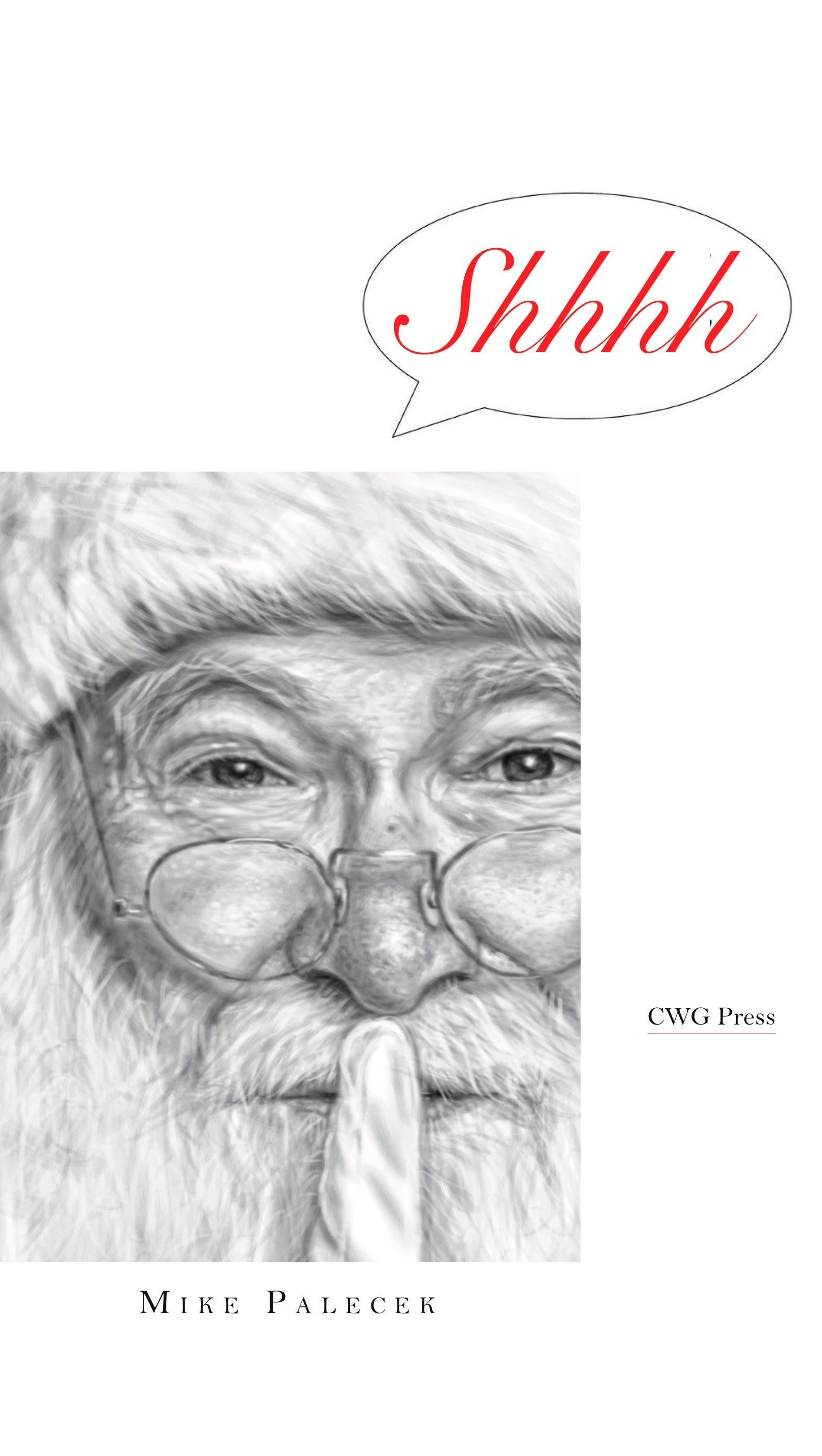
So he took the job and he sat in the big chair, a big cushy red chair in the middle of this big display, with all the decorations and the parents and kids, all smiling, pointing at him, taking pictures, perfect music playing from somewhere.
He was having a blast, found out he liked being right there, in the middle of the action.
“And what would you like from Santa?
“Okay, we’ll see what we can do?”
“We?”
“Me and the elves, you know.”
Then there was this little girl with black hair down past her shoulders. He’d spotted her when she was way down the line, staring at him, direct eye contact, checking him out.
Most of the kids just smiled, hopped up and believed.
This black-haired girl in the red and white dress and the white bow in her hair was not one of those. She knew something.
She was tenth in line, he counted.
Now sixth, fourth.
On the wall, high up on the wall, way up, a clock
Shhhh
16
hanged probably by one loose nail, and it was a big clock, made to look old and real, and what it really looked like was that it was meant to make this whole place look like an old-time department store where Christmas really happened, years ago. It was one of those clocks where the second hand does not sweep, but steps around the face, marking each second in wet cement. And maybe if it was quiet you would hear it.
She was second in line after this red-freckled boy wearing the Star Wars coat and stocking cap.
“Okay, Johnny, there ya go!”
He gave the boy a boost down.
“Bobby,” said his mother standing there over him with no expression.
“Good ol’ Bobby, Bob ... Roberto! Okay, Merry Christmas!” he waved a big white glove.
She was right there.
Didn’t get on his lap, just hopped herself up in the big chair next to him where an elf or Mrs. Claus sometimes sat, rested one arm on the armrest and leaned in.
“Well, hello there! And what’s your name?”
“Sally,” she said, shaking her head.
“Well, hello, Sally.”
“It’s really not important,” she said, “my name.”
“Okay! What can Santa get you for Christmas, uh ... Sally.”
“I don’t really need anything. I just want some information,” she said.
Shhhh
17
“Oh?” he said, folding his hands in his lap.
“What kind of information?”
She was going to ask him what was the truth, about Christmas, and then probably the Easter Bunny, and what was he supposed to do? He knew what he was supposed to do. For one thing, he was mic’d up. Everything he said and the kids said went out over a speaker and there were reasons for that, probably one so that the parents knew what the kids wanted and number two so the ones who were running this whole thing, the owners of the store could keep track of what their employee, Santa Claus, was doing, and maybe number three to lend an exciting air to the whole thing, otherwise there’s not too much going on except people waiting in line forever, getting tired of standing, and hearing the Hansons and Burl Ives and Bing Crosby way too fucking many times.
“Well,” she said, scooting closer on her big red chair as Perry Como told us to have a merry, little Christmas.
“Re-direct,” he could hear the Santa Coach tell him in the two-hour training session.
“How about a doll?” and he knew that wasn’t going to cut it just as soon as he said it.
“A doll?” she said.
“I’ve got lots of dolls, a whole room full. I could give you some dolls.”
Her voice boomed over the atrium area. Mothers smiled and chuckled.
Shhhh
18
“You are Santa, right?” she said.
And the room got fairly quiet.
“Ye-ees.”
“And so you know things, you know people, all over the world.”
“Yes, I do,” he said, confident in his answer, folding his hands more and sitting more straight.
“And you are good. And you are here to find out what we want, right?”
“Yes, little girl! Ho-Ho-Ho! Merry Christmas!”
He tried, he really tried.
She scooted to the edge of the big red chair, her legs in the laced stockings and red shiny shoes dangling.
“I want to know about September.”
“September? A beautiful time of year, not as great as Christmas though, of course. Ho! Ho! Ho! Merry Christmas!”
“No. A day in September.”
“Hmmm. A day ... in September? Should I guess.”
“No, that would take too long, I’ll just tell you. It’s the eleventh. September eleventh.”
“Oh, I see.”
“Who did 9/11?”
She used air quotes, both hands, then quickly switched back to gripping the arms of her big red chair.
“Oh.”
“That’s what I want to know.”
“I see.”
Shhhh
19
“That’s what I want for Christmas. I want to know. Will you tell me?”
And everything stopped. Nobody talked, nobody moved as Perry Como belted out, “hang a shining star upon the highest bough ...”
And because everything stopped he had time to think. ... He thought about that girl, seated right there, right now, making absolute non-aggressive, expectant, patient eye-contact with a man she suspects could possibly actually be the famous, one and only, godlike, saint of all times, Nicholas, Kris Damn Kringle, Father Christmas, Noel, The Santa Clause, how she deserved to know, because he did know, but nobody had ever told her and nobody ever would, or any of the children in line there, and how he knew he was supposed to think of something to say, pretty much anything but the answer, and how after all these years, it was still a secret, just like so many things that can never be talked about, ever ... especially not here, with a bright, young girl with beautiful black hair fixed with a ribbon by her mother and this perfect red and white dress and those red shoes who just wanted to know the truth of her life. Who she really was and was really experiencing and who were these people around her and what was she really expected to do as a bona fide actor in this god damn shit show.
The clock marked each second, then reluctantly moved on to the next one. Perry Como sang, “Have yourself a merry, little Christmas ... now.”
Shhhh
20
[Chapter two]
When life itself seems lunatic, who knows where madness lies? Perhaps to be too practical is madness. To surrender dreams — this may be madness. Too much sanity may be madness — and maddest of all: to see life as it is, and not as it should be!
― Miguel de Cervantes, Don Quixote
How many honest men were liars, brave men cowards, loyal men traitors, how many sainted men were corrupt, how many people in positions of trust had sold their souls to bodyguards, how many had never had souls? How many straight-and-narrow paths were crooked paths? How many best families were worst families and how many good people were bad people? When you added them all up and then subtracted, you might be left with only the children, and perhaps with Albert Einstein and an old violinist or sculptor somewhere.” ― Joseph Heller, Catch 22
There was once a people, some people.
They lived, and they got rich, by telling lies.
Where they came from [deep in the woods?] or got rich, how they managed it, how or why things had turned out as they had is really anyone’s guess.
For fun they wanted more stuff.
21
Monaco, seen pictures? That’s what people would do, anyone, if they could. They would dream and dream of that and get that, and a boat and go drink and ride around in the boat and come back and eat, and that’s what they would do if they could do anything. And that is the reason for all of this.
They did many things. At the same time as Three-Mile Island they produced The China Syndrome, which is incredible timing, you might agree. Right before Sept. 11, 2001, during that summer they had the movie Pearl Harbor appear in hundreds, thousands of movie theaters across the country, once more pretty good product placement, it would appear.
There was Walter Lippman, who preached about a class society of those who know and have and those who do not.
“Great vulgar masses of a largely ignorant public, steered by an elite or special class.”
And there was Karl Rove, who had learned, and now he taught others: “We’re an empire now, and when we act, we create our own reality. And while you’re studying that reality — judiciously, as you will — we’ll act again, creating other new realities, which you can study too, and that’s how things will sort out. We’re history’s actors . . . and you, all of you, will be left to just study what we do.”
And they tortured some folks, like ants with a magnifying glass or fireworks down their hole.
Told them they were going to get sick, told them
Shhhh
22
they were sick and told them they would be sick if they did not wear bunny tails, because of course.
Ears were not necessary, or noses, but the tails were life or death. They were.
And you would see the people, at work, at home, in school wearing their bunny tails which would keep them safe.
There now, a grown man, in the parking lot, climbing out of his car, a tall man, it takes forever for him to pry himself from the capsule, headed to the store, his children at home waiting by the window for his return, now shutting his car door, adjusting his bunny tail, making sure he has his keys, his billfold.
Shhhh
23
(Chapter three)
Tyranny in democratic republics does not proceed in the same way, however. It ignores the body and goes straight for the soul. The master no longer says: You will think as I do or die. He says: You are free not to think as I do. You may keep your life, your property, and everything else. But from this day forth you shall be as a stranger among us. You will retain your civic privileges, but they will be of no use to you. ... When you approach your fellow creatures, they will shun you as one who is impure.
― Alexis de Tocqueville, Democracy In America
And then, there it was.
Perfect.
As glass. As a lake with no wind, a boat, the rising sun just now beginning to glimmer, one fish jumping, one old man now casting his line and there it is, still in the air, his favorite coffee mug at his side, steam rising from the cup and the lake and ...
That’s how it looked to the exhausted walking man.
He might even have seen a boat and a lake in his condition rather than a small country home, white paint, green trim on the house and the out buildings, freshly mowed yard, the way a Coke machine and a Cenex
24
station must look in the middle of the desert ... kaftans, gandoras, shaylas on the clothesline ... a scene from the 1950s, the way Coke machines in the desert looked back then. It’s A Wonderful Life ... in the desert.
Like a painting with a few moving parts, just here and there.
Anyway.
He drew closer, bringing the inevitable chipping paint and broken bicycle wheel into view.
The lane with a middle line of grass wound gently from the road splitting one way to the house and the other to the garage, clearly more than a garage, a formal place of business with a vintage neon sign: Dale’s Motors.
One small door for foot traffic and one large one for cars, tractors, tornadoes perhaps.
One could go on and on in describing the place, the few these and those out over there just beyond the fence line, the smell of bread and pie and lilacs and wood smoke [perhaps imagined, but rightly so], the slap of the door as children rush out of the house, laughing.
The inside of the garage, how everything was just so, swept, papers in order, a little office area, just enough and a place, comfortable chair, fresh cigar smell and oil and steel, leather with an understated hint of whiskey, and an actual pop machine with bottles, for friends and, well, everyone.
Shhhh
25
A shrill whine pierced the air, a machine in use, grinding, fixing, creating.
The farm and the business were begun “in the day” by the father and grandfather Dale, maybe 1943, maybe earlier, or a little later, horses first, horses and tractors, horses and cars, motor homes, SUVs.
The garage was decorated inside and out, like the bedroom of a teenager with sports and music idols, with tin and magnetic and neon hangings: Pennzoil, Mobilgas, Pegasus, Route 66, a pinup calendar from 1958, green dinosaur.
On the far side of the building sat the red Impala, implying fixed or not fixable.
The man left the trail, crossed the tracks, the gravel road and hobbled into the lane, helped along by D.B. Cooper, his best friend in the world, that he’d just found lying by the path.
Howie Dale, son of Herb, grandson of Henry, walked up to him wiping his hands on a rag, wearing the loose-fitting grey work suit of a man in a 1950s movie or a moving painting. He talked as if continuing a conversation, that the limping man with the stick buddy had been sitting there all along.
“At least it’s not as humid today, yesterday was stuffy.
“Yeah, Wesley, I just don’t know,” he said.
“Just can’t find parts anymore.”
Shhhh
26
The man, Wesley, stopped, balancing with the walking stick soul mate.
They came together as mourners and walked together over to the coffin car, thoughtfully, heads down, considering what would be the right words to say.
Stopping at the front of the car, they each put a hand down to touch, rub, pat, now looking over the entire car to consider its lifetime.
“I love this car, I really do. I just can’t find parts.”
“What’s wrong?” said the man, Wesley. “With the car?”
“Oh, it’s the rings,” said Howie, “Howard” said the stitched name tag above his left side shirt pocket. And then he went into a disquisition on pistons and rings, cylinders, rods, bearings and pins that reminded Wesley of Goober, but could just have well been a professor at Harvard informing sophomores of the building blocks of string theory and the relativity of time and space, and Wesley followed as far as he could and then dropped back.
“I love this car, I really do.”
He rubbed the quarter panel with a clean rag.
“Trade it for a horse,” said Wesley. “Trade it for a horse or a cow, got one?” he smiled.
“Oh, I couldn’t do that,” Howie said, looking toward the pasture, adjusting his cap.
“What happened to your hat?” he said, turning back to Wesley.
Shhhh
27
Wesley touched his torn hat to say, oh, nothin’.
He was invited to stay for a meal and afterward he sat with Howie out by the fire pit, smoking, drinking whiskey. They talked about baseball and the weather and jobs they’d worked, about how things were different these days from other days which were different from previous days.
The fire snapped, crackled ... finally, if not totally believably, it popped.
Howie and Wesley saw each other across the fire, in and out of the smoke as sometimes the breeze took it and sometimes it sat.
Howie told about how one time he caught a fish in a boat in a lake not far from here, a giant northern pike and it pulled him all the way home.
“And how did he know where I live? That is what I would want to know.”
They watched the smoke and the fire and sipped their whiskey from tin cups.
“It’s like they don’t even want us to make it,” said Howie, “they just don’t want us to make it, nothing’s lookin’ good for the workin’ man.”
Wesley looked around, into the dark, into the fire as Howie talked ...
“You know we only got the one TV any more, don’t even hardly use it ...”
Wesley heard something about “burning books,” and the hand’s tail on Netflix ...
Shhhh
28
“’Course that’s not for me. I can’t sit still for that, but it makes you think, wearin’ masks. Some ol’ boy said how you gonna tell the bad guys if everybody has on a stocking cap over their head. You can’t tell the good people from the crooks.”
Howie said that everyone he knows is fighting for their lives.
“There’s good and bad in everybody,” said Wesley, but not loud, not to get in the way of Howie’s having a good time lettin’ things out.
But Howie heard him.
He stopped and stared hard across the fire, moved forward on his chair and put his elbows on his knees. The flames danced on his face.
“I heard that, Wesley,” he said. “I damn sure heard that. Just from me, there’s things I think and maybe some I done that I would be ashamed to tell you, but I’m not all bad either, just knowin’ that’s the only thing that keeps me out of a high tree.”
Wesley nodded and did not look away in case Howie wanted to talk more.
“I think of the good in me and then I keep goin’,” he said, “and try to do good with the next thing, whatever comes.”
He sat back and Wesley felt like Howie had kind of said, at ease, and so he sat back, too. But just as quickly Howie was back on the edge of his chair and getting his hair almost on fire, not quite, but pretty close.
Shhhh
29
“And I’ll tell you this, too.”
He paused and so Wesley thought he probably was supposed to say something so Howie could say the rest of what he had.
“What’s that?”
“Well, I think if everyone knew that,” he said, kind of slowly, “that he wasn’t the only one, then things would go easier on him, in his own head and not so much think he’s a bad person.”
He sat back again and from the back of his chair and almost out of the light he said, “anyway, that’s what I think.”
“Feed the good one,” said Wesley, “let the other’n die right out.”
This time Howie stood straight up.
“That’s it, exactly!” he proclaimed.
The next morning Wesley and Howie sat in the broad back lawn under two giant trees in full summer glory like two southern gentlemen, sipping coffee and contemplating the sun from under the shade, sitting in fading red metal lawn chairs. A boy came out, another, one working a yo-yo, the other licking a double-decker chocolate and vanilla ice cream cone. Like cats they crawled up a nearby tree and sat on a big horizontal branch like it was the kitchen table. They wore overalls and dangled their bare feet, listening in, just knowing it was allowed, they had all the right in the world.
Shhhh
30
Like a scene in a play the boys were followed out the slapping screen door with the flies hanging on for dear life by two young girls in braids, one swinging a violin and bow in her hands and the other holding a harmonica in her mouth with her teeth and lips. By the look in her eyes you could just tell she knew how to play the thing.
“Who are you people?” said Wesley as the girls sat on the grass cross-legged.
“Whattaya mean?” said Howie.
“You know what I mean.”
“Yep, I do.”
“Nobody likes us,” said one of the girls, the brown-haired one tuning the fiddle.
The humid “why,” hanging in the air, was implied by Wesley’s silence.
“Oh, that can’t be true,” he finally said.
“No. It is true,” one dryly verbalized the maxim.
“Because we are different,” said the other girl, her hair tending toward sun-tea blonde.
She went on about their being Christian, home-schooled, playing music, reading books, not watching TV.
The boys, boldly yellow-haired, like two sunflowers, younger than the girls, now hung upside down by their legs.
“You do?” said Wesley. “Yes, I do,” said Howie as if the girls had said not a word.
Shhhh
31
“Do what?” said one of the boys trying to grab grass with his swinging hands.
“I just do,” said Howie. “We all do, of course.”
Wesley considered this Rockwell America of good people, and how from this could have come the slaughter of Indians, bombing of Dresden, Tokyo, Hiroshima, Vietnam, 9/11, the CIA all over the world, Iraq, Afghanistan.
The mother flew out the back door with the slapping again of the screen door and the flies Wallenda swinging this way and that, still clinging, still seeking some way in “there” from “here,” not having discovered yet that the only way was to let go, truly let go. She wore a flowing summer dress, all colors, with bees and flowers, giant bees, something a dental office team might wear as a uniform on Fridays if the flowers were toothbrushes and the bees were beavers with giant shiny white teeth.
“Back in the ‘50s, ‘60s, ‘70s,” she said, taking her seat on stage, a faded red metal chair left for her, crossing her legs and wiggling her bare toes and red-painted toenails.
“They (she used air quotes like a pro) decided to create order out of chaos.”
“Ordo ab chao,” one of the swinging boys seconded that in motion.
“I just knew you were going to say that,” said one
Shhhh
32
of the girls, the one with the violin just now tucking under her chin.
“Martha thinks she’s a telepath,” Howie, shaking his head, said to Wesley.
“Not a telepath,” said Martha, “I mean, yes, that just wasn’t a good example of telepathy.”
“That’s where all that came from,” the mother looked straight at Wesley.
“Trust me, I know.
“Or I think I do.”
Martha picked out, pizzicato, the lead-in to the Deliverance song on her violin.
Da-da-da-da-da-da-da-da-da.
“Kidding,” she smiled at Wesley.
She fit the wood under her chin, rested the bow on the strings and made eye contact with the other girl.
“Rebecca?” she said.
Rebecca cupped her hands around the harp and played the cross-harp intro and was joined by Martha.
“So,” said Mary, then putting one finger in the air to say hold that thought she got up and hurried in her bare feet and flowing dress toward the house.
One boy walked to the edge of the yard, by the trees, and placed something on a rock. The other boy jogged to the big open field on the side of the house where two chairs waited, joined quickly by the other blond youngster.
Shhhh
33
Howie watched Wesley observing the boys.
“Putting out a little somethin’ for Bigfoot,” said Howie, nodding at the apple sitting on the rock at the edge of the trees, then pointing over his shoulder with a thumb in the general direction of the now occupied chairs, “CE 5. Close Encounters of the 5th Kind, trying to call in alien ships. They use their minds like duck calls.”
“No shit?” said Wesley.
“Hasn’t worked yet,” said Howie, “but who knows, ya know?”
“Yeah, that’s right,” said Wesley.
“Bigfoot?”
Howie didn’t seem to hear. He was more focused on ... “Hey, Mary! Over here!”
He waved his hands over his head for her to bring over the pan she was holding with the red and white Mrs. Santa oven mitts with the white towel draped over that which could only be freshly baked bread just out of the oven.
“You have to get up,” she said over her shoulder as she set it down on the picnic table.
The boys, head down, lunging forward, sprinted over. The girls walked. Everyone stood around, lounging in the bread-air aroma, like a bread sauna, patient, not over-eager, everyone in bare feet, even Howie, Wesley just now noticed. He looked down and tried to see his toes wiggle inside the steel-tipped boots.
Shhhh
34
One at a time they plopped down into the thick grass, legs crossed, leaning on each other, tearing off bits of the warm, thick, moist bread and letting it melt in their mouths.
Ooo-ooo, one ran around the table, mouth open like a carp, waving a hand in front of her mouth.
“So,” said Mary, taking her long black plait and draping it over her shoulder.
“Wesley.”
“Yes’m,” said Wesley.
He had never said yes’m before in his life, it just came out.
“What are you doing?” she said.
“Well ...”
“He gettin’ hnnwws caaa,” said Howie through a mouthful.
Someone farted and nobody seemed to notice.
Mary translated, “he’s getting his car,” as if Howie often talked with his mouth full of fresh bread.
“Yeah, but I can’t fix it.”
“Then it can’t be fixed. So, you’re going to make him walk back home.”
“Got no home,” Howie said.
“He talks, right?” said Mary, as both she and Wesley looked back at the walking stick leaning against a very large oak tree in full plumage, and then looking back, neither saying anything.
Howie put bread in his mouth and looked away.
Shhhh
35
Another fart dampened the air.
Wesley looked around like is anybody going to say anything?
They ate until the two loaves of bread were gone.
They sat in the grass, licking their fingers.
Without anyone saying anything they pushed up off the grass and it might sound like a fairy tale cliche, but three people farted as they stood, not at the same time, but like three bottle rockets, all lined up and prepared ahead of time.
They stretched and bent over, touching the grass with the tips of their fingers and some with their hands flat. They crossed their legs and did that and stood up and stretched their arms to the sky and then out sideways. They did different poses, not all the same one, some sat and stretched, others with their legs out back and their arms out front, and Howie lay flat with his face in the grass and his hands and legs out like he was Superman flying, except not very high or fast, or at all.
Wesley hunched in the grass with his legs crossed, kind of bending over as if he were exercising and meditating at the same time, kind of not, his eyes, darting this way and that, his nose sniffing like a bunny, vigilant about from which direction the next fart would fly.
They sat pretty much all leaning back on their hands, wiggling toes, Wesley still attempting to see movement in his boots. It had been awhile since he had said anything and so he thought he should.
Shhhh
36
“The bread was great,” he said.
Mary smiled and stretched her face and closed eyes to the sun. Her hair now down her back, she swayed her head so the perfect plait swung like a pendulum. Wesley couldn’t help thinking of the sword of Damocles. It made no sense, not here, but with what he had in mind, his thoughts were dark, even sitting here with this family in the sun in the grass after eating freshly baked bread and who knows when that will ever happen again.
“Who’s your neighbors?” he ventured.
“We don’t really associate with the kolkhoz,” said Martha. “We really don’t,” said Rebecca, “sometimes they drive past and stare.”
“Sometimes we wave,” said Martha, “sometimes we stare back.”
“Earl gave the finger once,” said Martha, and one of the boys, Earl, apparently, sat high in the grass and puffed out his chest defiantly.
“So did Ray,” he said. The other blond boy, who lay on his back with his legs crossed, raised up one hand to wave.
Howie took the opportunity to crawl on his hands and knees to the picnic table and pull himself up to sit. He stretched his legs out and rested his elbows on the table, pushed up the bill of his cap and gave Wesley a perhaps abbreviated version of the history of the Dale family, anarchists, Wobblies, unions.
Shhhh
37
“There’s really none left around anymore,” he looked toward the dirt road.
“Just us, I guess.”
“They don’t have to burn books these days, nobody wants to read ‘em,” said Howie, and Wesley looked at him like what’s that got to do with ...
Mary stepped in to explain.
“We don’t really watch TV, you knew that, well, the kids have this little library out by the road and they put books in it for people to take and bring back.”
“But nobody does,” said Earl.
“Nobody does,” said Mary.
If you put chocolate bunnies in there, they’d take ‘em’.
We should put chocolate bunnies in there.
Maybe we’ll put chocolate bunnies in there.
Sarah would like chocolate bunnies, one of the girls said, looking at Earl.
There’s a neighbor girl. We don’t know her name, exactly.
Earl turned red and ducked his head.
“Soooo,” said Mary, as if wanting to get back to something begun earlier.
“What are you going to do?”
“Well,” said Wesley as he looked at Howie.
“We’re tradin’ the car for a ...”
“No!” said all the kids at once.
Shhhh
38
“Which one?”
“Not Walter!”
“Not Bunny!”
“Not Donny!”
“Not Maude!”
“No, no,” said Howie.
“Or Woo, mom, not Woooo.”
“No, not Woo,” said Mary.
“Or DaFino.”
“Not Karl Hungus!”
“You’ve got lots of horses.”
“Those aren’t horses,” said Howie.
“They are llamas, all but one, the emu.”
“DaFino yeah,” said one of the girls, Wesley didn’t catch which one.
“We’ve only got the one horse,” said Mary. “It’s kind of a one-horse farm.”
What do you need a horse for? asked Mary.
Well, I don’t. I need my car.
But.
Yeah, but.
Besides getting back to town, she said.
Well.
One of the boys was searching the grass all around him.
The other boy took it upon himself to explain that
Shhhh
39
his brother thinks he still has another hunk of bread but he doesn’t, anymore.
“I wouldn’t worry about it too much, honey,” said his mother, “there’s other things in the world that might need your attention.”
Wesley had noticed they had a name for practically everything.
The entire farm was Monticello, while the house itself was Day House. Their car, a mint condition 1940 black Hudson Sedan, was Clyde, and the big oak was Home Tree.
“Go get John Brown,” Mary suggested to Howie.
“The horse?” asked Wesley.
“No, the gun,” said Mary.
“You’re needin’ a gun.”
“Actually.”
“Because some people need killin’. You’ve got that look. I’ve seen it before.”
“We don’t really have a name for the horse, yet,” said Howie as he walked toward the house, “ ‘cept Spot.
“He’s a good horse.”
The boy who had given up searching for bread had walked over.
“Traded for a tractor. It was ancient but in mint condish. We took it to parades.”
“We din’t need a horse, but the guy needed a tractor.”
The other boy had now arrived.
Shhhh
40
“Saddle came with it, bridle, all that.”
“C’mon, we’ll show you. We think it’s a Pomeranian.”
One of the blond boys offered Wesley a hand to get up.
The three of them walked toward the fence and the pasture.
Everyone got up, gathered things and slowly followed along.
They stood at the fence, watching the one emu and the llamas, all grazing, swatting flies anyway they can.
They saw a very black figure raising up its front legs, turning circles, chasing the llamas, then running when they chased it back.
“Actually,” Mary sauntered over, “we think it’s a Friesian, Black Belgian, very beautiful, as you can see. Likely stolen, but that’s not our problem, not yet anyway.”
One boy, maybe Earl, put his fingers to his mouth and whistled expertly. The emu and llamas shot their ears up and looked around. The horse brightened and trotted over to the fence where they all stood. It looked tall, braided hair, no white anywhere, pure black.
He dipped his head for Earl to pet him. The ears twitched.
Rebecca whispered to Earl, an idea she just had, about how they could bring out chairs to the fence and
Shhhh
41
their instruments and have a concert and the llamas and emu would be their crowd.
“They’ll love it,” she said, clutching her chest with one hand, out of breath due to her own great idea. Earl’s eyes went wide. He turned to whisper to Ray.
In the meantime Mary, standing next to Wesley, had asked him how he had come to this station in his life. He told about the Thanksgiving dinner and Christmas.
“That couldn’t be beat,” mumbled Mary.
“It’s all fake wrestling,” said Howie, with the gun draped over one shoulder, “we keep falling for the same trick over and over.”
“Oh, well,” said Mary, “that’s a conspiracy theory. You’ll lose people if you start trying to convince them like that. You need something more positive. Make sure to start your revolution far from here. Some of us don’t care to be martyrs,” she said as she turned to say hello to the horse and Howie moved into her vacated space to show the gun to Wesley.
“Between the devil and the D.B., deep blue sea.”
Mary, petting the horse’s head, turned and shouted over her shoulder at Wesley.
Mary climbed onto the horse’s back. She pushed up, balancing, stood on it in her bare feet, shook her fist in the general direction of the rest of the world and shouted.
“I just don’t believe you! ... About anything!”
“Here, you need a new hat, a cowboy hat if you’re
Shhhh
42
gonna be a cowboy,” one of the girls handed a hat to Wesley.
He took off his cap, dipped his head to place the new hat, looked around to see how it looked and seeing approval, flipped the old cap and it landed perfectly on a fence post.
“Meant to be,” said Mary from her high perch.
They retired back to the picnic table to play a board game and eat homemade ice cream, while listening to the radio playing in the kitchen window.
“The Grand Candyland Board,” said Mary to herself, with others right there.
“You would prefer a white horse, I assume?” she looked at Wesley.
Martha and Rebecca played a little concert.
Wesley and Howie again sat together in the metal lawn chairs.
“So, I can really have the horse?”
“Of course.”
“What am I gonna do with a fuckin’ horse?”
“Not my problem, was your idea. You’ll fuckin’ figure it out.”
They sat in silence, listening, dozing. A car ran past on the road, raising dust. Wesley noticed Earl sat up a little to see who it was, and also that Howie was talking, probly had been talking for a while.
“They realize they can say anything and anybody
Shhhh
43
will believe it. Buried at sea. Russians did it, are doing it, will do it. Test the mass psyche to see where it’s at. All the hints in movies. They’re just havin’ fun, ‘cept when people die.”
Wesley felt obliged to say, “yep.”
Earl and Ray, now joined by Martha and Rebecca, returned to the giant side yard trying to call in ETs to tell them about their concert.
Mary gathered the dishes and turned down an offer of help from Wesley and one beat late from Howie.
She returned a bit later, carrying a green and white lightweight chair.
They talked about taoism, cow-ism, wow-ism, also Bukowski-ism, don’t try-ism.
“I should just stay with you here,” said Wesley.
“Yeah, you could, but we’ll always be here,” said Howie.
“You got to go if you want to come back,” said Mary.
“It’s like Fight Club,” she said as she answered a text from one of the girls.
“What?” said Wesley.
“Oh, letting go of our comfort zone and jumping into the unknown without safety,” said Howie.
“I love that show. It’s all about thumos.”
“Thumos?”
“Look it up,” said Howie.
“Letting the things that don’t matter slide,” said
Shhhh
44
Mary, smiling at something she’d received on her phone.
“I know exactly what you’re doing,” she said.
“I’m not sure I agree,” she said as Howie, sensing the diversion, leaned over his chair to light a cigar.
“It’s the authority song,” she said.
“Mellencamp, come out grinnin’. You know, when he’s born he comes out grinning, and the whole song is about fighting and losing. He’s not grinning because he’s assured of victory or that he’s a bully, but because he just wants to fight, especially against the odds, knows he’s going to get his butt kicked, but just fuck it, let’s go. And he’s just amused by the prospect of the fight, maybe knows he ain’t much and neither are you ... but let’s go. Fuck you.”
“An awful lot in a few words,” said Wesley.
“They have to,” said Howie, “songs can only be so long.”
“You know what Jim Garrison said, don’t you?” said Mary.
“No.”
“He said there is no one else on the planet to tell what he knew. On the planet. There was nowhere to go. That’s where you are. You have no choice but to take that gun and that hat and that horse, ride off in to the sunset and either hang yourself, shoot yourself, or fight.”
“And then die,” said Mary.
Shhhh
45
“Mor’n likely,” said Wesely.
“Nothing else to do,” said Howie, blowing smoke and staring at the cigar.
“Well,” said Wesley, wondering how they knew.
“Why not you guys?”
“It’s too late for me,” said Howie.
“I’m older than you,” said Wesley.
“That don’t have too much to do with it,” said Howie, “it’s just too late for me.”
He scooted up to the edge of his chair and leaned forward as he did when he felt he had something very important to say.
“We love doin’ what our daddy’s done. That’s a good feeling. I’ve got a good feeling, be that good or be that evil, and I’m not goin’ anywhere. The kids are all gonna be car mechanics and live on this place for another hundred years, and by that time llamas will own the county and there’ll be an emu mayor.”
Wesley thought about his mother. She was a teacher. She would say she’s now pushing up daisies. Wesley didn’t like plays then, but now it’s coming to him, slowly, day by day, minute by minute.
Pages will be written about this, she said. They will, that’s just how it happens. Not by me, not by you, but somebody, somehow it happens. And all we have to do, is our part. It’s easy, just find out what your lines are and do your part. You shouldn’t be concerned with turning any pages. You are in the book, and that’s cool. So fucking cool.
Shhhh
46
Howie sat back, crossed his legs and took another puff.
“That’s my story.
“I’m stickin’ to it.”
Wesley smiled.
Shhhh
47